Today, one of our expert
2nd Street District massage therapists discusses what is a "knot."
What is a muscle knot?
"What
is that thing, anyway?"
I'm always getting asked this question. I'm a massage therapist, and "that sore, crunchy thing" is a muscle knot. But what actually is a "knot"?
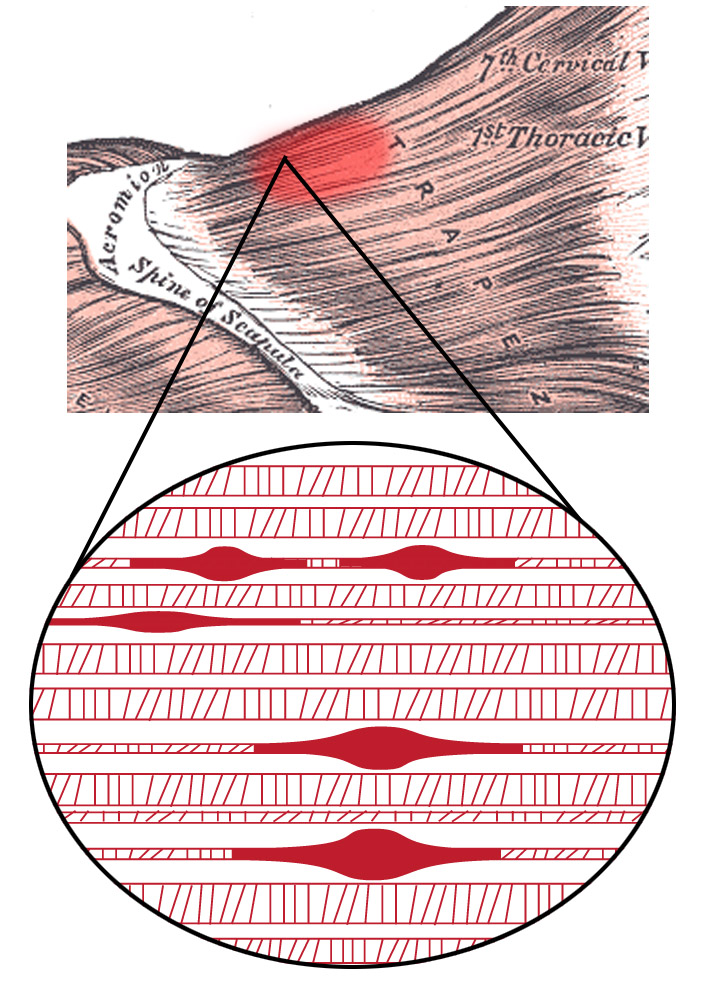
Muscle knots are small bumps that commonly appear on the back, neck, or shoulders and usually feel tender or sore when touched. They are comprised of muscle fibers and bands, which form a bump or “knot” when tightened under stress or tension. While knots are the commonly used term among the general public, medical experts refer to these spots as myofascial trigger points, which are classified as either active or latent.
If a trigger point is classified as latent, you’ll only feel pain when the area is pressed. On the other hand, active trigger points can produce random feelings of pain even without being touched.
It’s important to note that muscle knots/trigger points can also cause pain to radiate to surrounding muscle tissue and even other areas of the body in some cases. For example, a trigger point in your trap muscles (upper back) may radiate pain into your lower back, and it could even lead to pain in a completely different area of the body such as the calves.
What does a muscle knot feel like?
As noted, muscle knots are small bumps that feel painful to the touch. Knots can vary significantly in size, from the size of a pea up to a golf ball or larger. In most cases, you will not be able to see a muscle knot but will be able to feel it when touching the area. Muscle knots will feel swollen and tense compared to the surrounding area. When feeling around to find muscle knots, it’s important to be gentle because aggravating them can lead to more inflammation and discomfort.
Where do muscle knots occur?
Muscle knots can occur anywhere in the body where there is muscle or fascia (connective tissue). However, the most common places we see muscle knots develop are:
- Neck (typically on the sides)
- Shoulders
- Back (upper and lower)
- Buttocks
- Legs (quadriceps, hamstrings, and thighs)
- Upper arms
[caption id="attachment_2799" align="alignright" width="240"]
photo by woodleywonderworks[/caption]
What causes muscle knots?
It would probably be more accurate for me to say that no one really agrees on every aspect of what constitutes a knot, how you get knots, and how to get rid of them. However everyone agrees that a knot forms in muscle tissue. This includes connective tissue such as fascia and tendons. Blood almost certainly plays a role, as does our nervous system. They are raised from the rest of the surface, and sometimes they are tender.
The most common causes of muscle knots are:
- Stress and anxiety
- Overexertion (such as overdoing it while exercising)
- Poor posture
- Sitting for too long
- Unhealthy eating
- Dehydration
As noted, knots tend to form in stressed or damaged muscle. Overdoing it in the gym or on the trail will certainly aid this, but most massage therapists I work with are more inclined to find knots in muscles associated with desk work. These associate with the commute and compute postural distresses of holding your head and arms away from your body for too long.
Knots, as we vaguely understand them, are also likely to form in
individuals who are stressed or have high anxiety. I don't mean to overstep my scope of practice here, but I will simply observe that people undergoing emotional stress due to family, career, or other life events
may be more likely to develop knots as a result of the physical manifestation of that stress in the muscles. I'm constantly hearing, "Oh I keep all my stress in my neck and shoulders." And I often find knots up there.
If you frequently deal with muscle knots, examine the causes above and see if there are any lifestyle changes you can make to help prevent knots from forming in the future.
What are muscle knots that crunch with massage?
Some knots seem to invest more than one muscle tissue. Comprised of inflamed myofascial layers, and almost always including a concentrated degree of connective tissue, these knots feel gristly, and their size does not predict sensitivity to pressure. These knots tend to sound and feel "crunchy." I've heard this crunchiness comes from either connective tissue build up or from calcium crystal build up.
Essentially, muscle knots have reduced blood flow and circulation, which means toxins can become trapped in these areas. Over time, trapped toxins will solidify in the muscle knot if not dealt with, resulting in hard, crunchy bumps. To get rid of crunchy muscles, you’ll need to break up these deposits by gently massaging the area and encouraging circulation.
How to get rid of muscle knots?
Keeping in mind that muscle knots seem to form in relation to how we use our bodies, I would first suggest taking the time to assess your lifestyle and how you inhabit your body throughout the day. You may be able to change a habit or arrangement so that you don’t form the knots as quickly in the first place.
If you find that lifestyle changes aren’t helping to the degree that you need relief, massage can help get rid of muscle knots.
Most therapists will treat knots of any variety with localized pressure delivered directly to the knot. More sophisticated practitioners, whether from training or experience, will undoubtedly apply different techniques to your knots based on what they feel. Generally speaking, true trigger points respond better to direct pressure than the more gristly "adhesion" knots. Releasing trigger points in this way can relax the entire muscle. Adhesive knots seem to respond better to being "ironed" or "combed" out of the tissue. Sometimes separating one muscle from the other through movement can deal with those types of knots.
If you’re dealing with muscle knots and seeking relief, book a massage with our experienced massage therapists. Massage therapy helps treat knots by increasing circulation and improving blood flow, which loosens stiff muscles and relieves tension. Choose from several types of massages and get a thorough consultation with your massage therapist to address specific pain points. Book now or give someone else the gift of relaxation with a gift certificate.


Leave a comment